
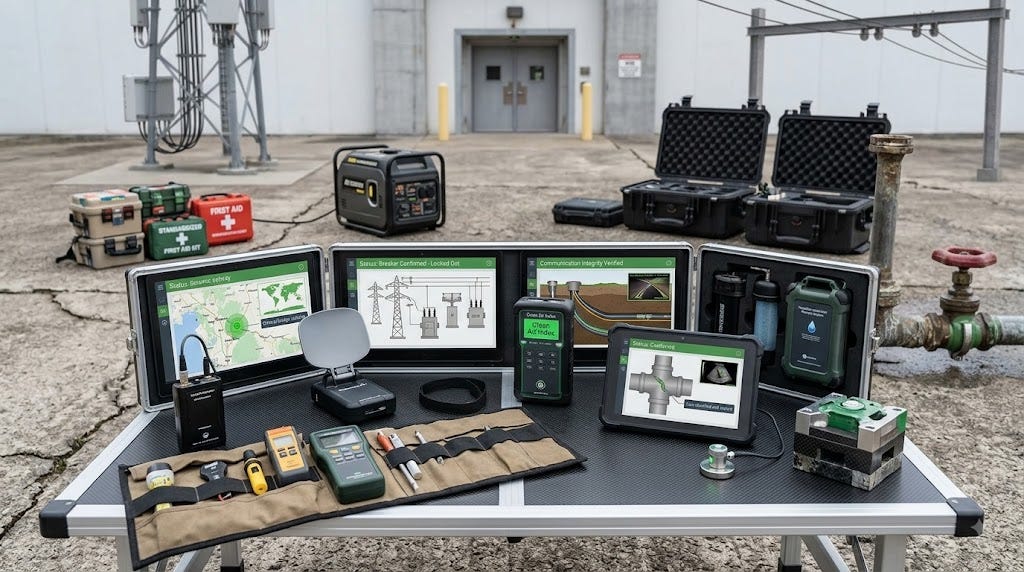
There’s a premise underlying all of this: most houses have one water main, one power feed, one gas line, one internet connection. If that one gas or water line breaks or gets cut off, you lose that utility completely.
Most people don’t think about utilities until they’re gone. They flip a switch expecting light. They turn a handle expecting water. They set the thermostat expecting heat. When the grid fails, when the water main breaks, when the pipes freeze, those people are suddenly scrambling.
You don’t have to be one of them.
Identify Your Single Points of Failure
Start by mapping your utility systems exactly as they come into your home. Electricity. Water. Heating and cooling. Communication. For each one, ask: where does it come from? Is there only one line feeding it, or are there backups?
Most houses have one water main. One power feed. One gas line. One internet connection. These are your single points of failure. If that one line breaks or gets cut off, you lose that utility completely.
Identify which ones matter most for your family. For most people: power and water are non-negotiable. Heating or cooling depends on your climate. Communication matters if you need to coordinate with family or call for help.
For each critical utility, ask the harder question: what fails first when supply gets interrupted? In a power outage, medical equipment stops. In a water disruption, sanitation breaks down. In a heating failure, pipes freeze and burst. Know your vulnerabilities before they become your problem.
Build Redundancy Into Your Systems
Once you know where you’re exposed, build backups.
For power: generators, solar panels, battery storage. Pick based on your budget and what you need to keep running. A small generator and some deep-cycle batteries will keep essentials alive during a short outage. If you want to think longer-term, solar with battery storage is the real answer — it runs as long as the sun does.
For water: storage tanks, filtration systems, rainwater harvesting. A 55-gallon food-grade barrel costs under $100 and holds three days of drinking water for one person. Two or three of those, plus basic water purification (boiling or filter cartridges), gives you real resilience. If you have the space and budget, a cistern or larger tank system pays for itself in a grid-down scenario.
For heating and cooling: understand what you have now and what fails first. If you heat with natural gas and the power goes out, that furnace won’t run. A backup heat source (wood stove, kerosene heater, even propane) keeps your house habitable. For cooling in hot climates, shade, ventilation, and water are your friends — not an air conditioner running on solar.
For communication: know how to reach family members without the internet or cell service. A paper map, a written list of phone numbers, a plan for where to meet. In a real crisis, the cell network gets overwhelmed. Radio communication (even cheap CB radios or Family Radio Service handsets) works when nothing else does.
Tailor It to Your Household
Your backup plan isn’t generic. A household with someone on a CPAP machine needs different power resilience than a house without medical dependencies. A family with a toddler has different water needs than a single person. An elderly parent with mobility issues needs backup heating and cooling to avoid heat stroke or hypothermia.
Look at your specific vulnerabilities. Medical equipment? Money and space for redundant power. Young kids? Water storage and sanitation rank high. Cold climate? Backup heat is not optional. Write these down. They drive your priorities.
Practice the Plan
A backup plan that lives on paper is useless. Test it.
Try a practice power outage: turn off the breaker to a room and live in it for an hour using only your backup power and water. Does the generator start? Does it power what you thought it would? Does your water filtration actually work, or is it too slow for real use? These are the questions you want answered in practice, not in crisis.
Walk your family through the communication plan. If the grid goes down and everyone splits up, where do you meet? How do you know everyone’s safe if you can’t text? Drill it once. Everyone will remember it better for the second time.
Keep Inventory, Update Regularly
Write down what you have: generator model and fuel type, battery capacity and charge status, water storage location and volume, filter cartridges and their lifespan, backup heater model and fuel supply. A simple list. Keep it where your family knows to find it.
Review it every year. Fuel degrades. Batteries lose capacity. Filter cartridges expire. Solar panels degrade slowly. Water storage can leak. This isn’t a set-it-and-forget-it system. Maintenance keeps it alive.
The difference between confidence and chaos is knowing your infrastructure. Not worrying about it. Knowing it. You know how much water you have stored, where it is, and how to purify it. You know your backup power, its capacity, and how long it runs. You know where heat comes from if the grid fails. You know how to reach your family if the network doesn’t.
That’s not paranoia. That’s knowing the ground you stand on — and preparing to stand on it alone if you have to.
SFC, U.S. Army (Ret.) — 25 years in uniform, three combat tours in Iraq. Senior Master in martial arts. I teach families how to survive and thrive through preparedness, self-reliance, and community. Based in Copperas Cove, Texas.
This is the second article in a series on assessing and hardening your home area. First: Know Your Neighborhood. Next: Securing Water in a Crisis.